Be the first to write a review
0%
(0)
0%
(0)
0%
(0)
0%
(0)
0%
(0)
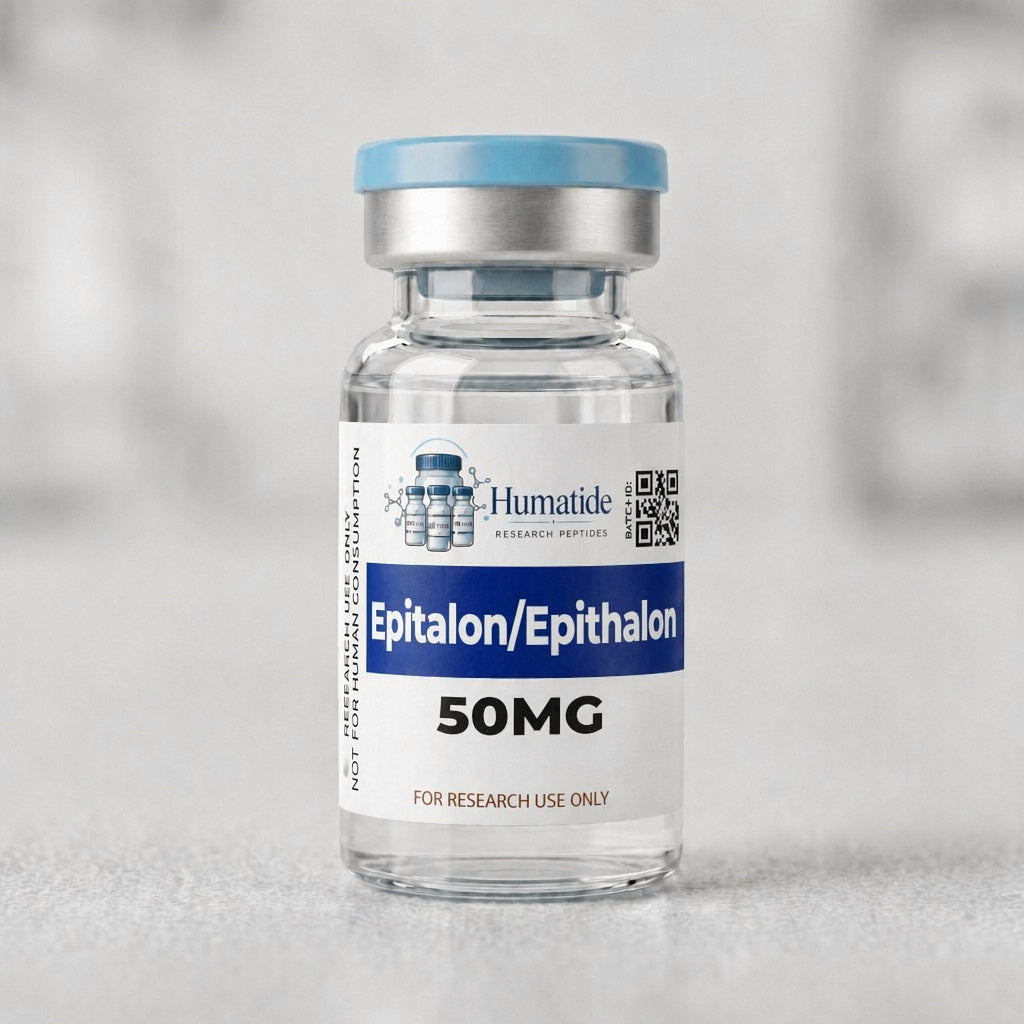
Epithalon (also known as Epitalon) is a synthetic tetrapeptide derivative of Epithalamin composed of four amino acids (Ala-Glu-Asp-Gly). Primarily studied for its potential anti-aging properties, research suggests it may influence telomere length and activate telomerase, the enzyme that rebuilds telomeres (the protective caps at the end of chromosomes).
| Property | Value |
|---|---|
| Peptide Sequence | Ala-Glu-Asp-Gly |
| Molecular Formula | C14H22N4O9 |
| Molecular Weight | 390.35 g/mol |
| CAS Number | 307297-39-8 |
| PubChem CID | 219042 |
| Synonyms | 307297-39-8, Glycine, L-alanyl-L-alpha-glutamyl-L-alpha-aspartyl-, Ala-Glu-Asp-Gly |
Epithalon, also referred to as Epitalon, is a synthetic peptide that has been studied for its possible involvement in cellular aging processes. Experimental investigations suggest that it may interact with telomerase activity and influence melatonin production. Research has also explored its potential relevance to areas such as oxidative stress, gene regulation, and circadian rhythm.
Alternative Names: Epitalon, Epithalone, Epithalamin
Laboratory studies suggest that Epithalon may influence the regulation of certain genes. Findings indicate possible interactions with promoter regions of genes linked to immune system function, extracellular matrix maintenance, and cellular signaling. Experimental data also propose that Epithalon may modulate histone-DNA interactions, potentially altering chromatin accessibility and influencing transcription processes. Research in stem cells has suggested an upregulation of markers associated with neuronal differentiation, which could point toward possible roles in epigenetic regulation.
Research on rodent and primate models has examined whether Epithalon may play a role in melatonin synthesis. The peptide has been studied for its potential influence on enzymes and proteins associated with circadian rhythm, suggesting a possible connection to the regulation of sleep-related hormonal cycles.
Studies on oocyte models have proposed that Epithalon may help preserve cellular structure during the aging process. Evidence includes observations of reduced oxidative stress markers, improved mitochondrial parameters, and decreased indicators of DNA damage. These findings suggest potential roles for the peptide in supporting cellular stability under conditions of stress.
Rodent experiments have investigated Epithalon in the context of cancer research, with particular attention to its potential modulation of circadian-related genes. For example, PER1 gene activity, which is often reduced in tumor progression, has been examined as a possible pathway of interest. Preliminary data suggest that Epithalon may influence tumor development and radiation sensitivity, though further research is needed.
Epithalon has been explored for its possible impact on extracellular matrix (ECM) proteins, such as MMP2, which are associated with tissue remodeling. In animal studies, peptide exposure was linked with increased fibroblast activity, suggesting potential roles in connective tissue processes. Investigations have also considered whether Epithalon may interact with enzymes involved in programmed cell death, raising questions about its relevance to cell survival.
Rat models of retinal degeneration have been used to evaluate Epithalon’s potential impact on eye structure and retinal bioelectrical activity. Some studies suggest improvements in structural preservation and functional outcomes, though the mechanisms remain under investigation.
Research on Epithalon spans diverse themes, including cellular aging, gene expression, circadian regulation, extracellular matrix dynamics, and visual function. Findings are preliminary, and while they suggest multiple possible biological pathways of interest, further studies are required to clarify mechanisms and implications.
For Research Use Only
This compound is provided exclusively for in vitro laboratory research. It is not intended for human or animal consumption, diagnosis, treatment, or medical use. Not for dietary, cosmetic, or veterinary purposes. This product has not been evaluated by the U.S. Food and Drug Administration or any other regulatory authority.
Disclaimer
All information is for educational purposes only. Humatide makes no claims regarding efficacy or safety. Purchasers are responsible for ensuring proper handling and use in compliance with all applicable laws and regulations.
Terms of Sale
By purchasing from Humatide, you confirm that you are a qualified researcher with the knowledge and facilities to safely handle and store research chemicals. All sales are final. Humatide assumes no liability for misuse, misrepresentation, or unintended consequences arising from the use of this product.
ALL ARTICLES AND PRODUCT INFORMATION PROVIDED ON THIS WEBSITE ARE SOLELY FOR INFORMATION DISSEMINATION AND EDUCATIONAL PURPOSES.
The products provided on this website are intended exclusively for in vitro research. In vitro research (Latin: *in glass*, meaning in glassware) is conducted outside the human body. These products are not pharmaceuticals, have not been approved by the U.S. Food and Drug Administration (FDA), and must not be used to prevent, treat, or cure any medical condition, disease, or ailment. It is strictly prohibited by law to introduce these products into the human or animal body in any form.
Polypeptide Purity Control and Verification Technical System
Humatide.com provides peptides with purity exceeding 99%. Humatide achieves precise control and scientific verification of polypeptide purity by integrating advanced technologies and a full-process quality control system: In the synthesis stage, automated solid-phase peptide synthesis (SPPS) is employed to accurately assemble amino acid sequences. A gradient purification strategy ranging from medium-pressure liquid chromatography (MPLC) to preparative high-performance liquid chromatography (Prep-HPLC) is utilized, optimizing mobile phase composition and elution conditions based on the physicochemical properties of the target peptide (hydrophobicity, charge distribution, etc.) to efficiently remove impurities. For purity detection, reverse-phase high-performance liquid chromatography (RP-HPLC) serves as the core technique, separating components through the distribution difference of molecules between the stationary phase (hydrophobic packing) and the mobile phase (polar solvent). Purity is determined via retention time matching and peak area normalization. Meanwhile, electrospray ionization mass spectrometry (ESI-MS) is combined to precisely verify the molecular weight and composition through mass-to-charge ratio (m/z) analysis, eliminating structurally heterogeneous impurities. Quality management covers the entire chain from raw material acceptance, synthesis process monitoring to finished product release. A continuous quality fingerprint is constructed using multi-dimensional indicators (HPLC purity, MS molecular weight, solvent residue, etc.), and batch data traceability is achieved through a laboratory information management system (LIMS), ensuring each batch meets the prespecified purity standards. This system provides a reliable technical guarantee for preparing high-purity polypeptides through the organic integration of process optimization, multi-dimensional detection, and full-process quality control.
Concepts of High-Performance Liquid Chromatography (HPLC) and Mass Spectrometry (MS)
High-performance liquid chromatography (HPLC) is a separation technology widely used by Humatide for peptide purification. Driven by a high-pressure pump, the mobile phase carries samples through a chromatographic column packed with a specific stationary phase, achieving separation based on differences in the distribution coefficients of components between the two phases. It features high separation efficiency, fast analysis speed, and strong detection sensitivity, enabling precise capture of subtle differences between target peptides and impurities such as sequence analogs or deletion peptides.
Mass spectrometry (MS) is an analytical method that converts peptide molecules into gas-phase ions through ionization technology and separates/detects ions based on their mass-to-charge ratio (m/z). It can accurately determine the molecular weight of peptides and infer amino acid sequences through fragment ion information, serving as a key technology for verifying peptide structural correctness. The combination of these two techniques allows Humatide to establish a complete quality control system from both purity separation and structural confirmation perspectives. Both methods are high-precision peptide detection technologies that scientifically demonstrate the purity and composition of peptides ordered from Humatide.com.
Humatide is committed to translating cutting-edge analytical technologies into tangible quality assurance. Our peptide synthesis laboratories are equipped with high-resolution mass spectrometers and ultra-high-performance liquid chromatography systems. Through real-time detection and data comparison of samples at each production stage, we continuously optimize synthesis processes to ensure every peptide product is delivered to customers with exceptional purity.
Recommended Peptide Purity Levels
Humatide provides only the highest-purity peptides (purity ≥99%) for research and development. The minimum recommended peptide purity level for specific applications depends on the application:
• In biochemical research, peptides used for enzyme activity analysis typically require ≥85% purity.
• In drug development, peptides for preclinical trials must meet >98% high-purity standards to ensure biological activity and safety.
• For diagnostic applications (e.g., antigen peptides in immunoassays), recommended purity is 90%-95% to guarantee detection specificity and sensitivity.
Humatide is confident in the quality of all our products, implementing strict quality monitoring at every stage of peptide synthesis—from crude peptide purification to final product release. Through multi-step purification and verification processes, we ensure each batch meets or exceeds the purity requirements for specific applications. Examples of acceptable minimum purity levels are as follows:
High Purity (>95%)
• Polypeptide drug research and production
• Preparation of targeted therapeutic drugs
• Raw materials for biological diagnostic reagents (e.g., ELISA, immunoassay kits)
• Development of polypeptide vaccines (therapeutic/preventive)
• Preparation of targeting peptides for antibody-drug conjugates (ADCs)
• Polypeptide reagents for life science research (e.g., receptor agonists/antagonists)
• Research on targeting peptide modification for gene therapy vectors
• Development of polypeptide antibiotics/antimicrobial peptides
• Preparation of polypeptide hormone analogs (e.g., insulin analogs)
• Reference standards for biomarker detection
• Research on cell culture additives
• Synthetic peptides for protein structure analysis and functional studies
Moderate Purity (>85%)
• Early-stage activity screening in polypeptide drug research
• Peptide additives for industrial enzymes
• Signal peptide raw materials
• Surface modification of biomaterials (e.g., medical catheters, tissue engineering scaffolds)
• Preparation of agricultural antimicrobial peptides
• Cell adhesion research
• Raw materials for polypeptide surfactants/detergents
• Polypeptide reagents for preliminary mechanistic research in scientific studies
Lower Purity (>70%)
• Preliminary structure-activity relationship (SAR) studies
• Initial verification of protein binding
• Primary cytotoxicity screening
• High-throughput screening of polypeptide drug lead compounds
Please note
**We are not responsible for reconstitution or any issue that arise from it**
High-purity polypeptides are suitable for scenarios requiring strict purity. The ultra-high-purity peptides provided by Humatide can meet and exceed all prespecified purity standards.
To View the latest Certificate of Analysis (CoA) click the "View Latest 3rd Party Certificate of Analysis" button on the product page. Please use that if you are looking to buy as that is the batch you'll receive if you place an order. The QRCode will give you the Batch ID/Lot Number which is matched on the CoA to validate that CoA matches your specific vial. If you happen to get a vial that is from a previous batch select the "Previous Batch 3rd Party Certificate of Analysis" if your Batch ID doesn't match the latest CoA.
All CoA are searchable via the respective testers' website.
ILS Labs Verification is available on their website at:
To validate the CoA on the ILS Labs website enter the Access Code that is located on the bottom of the CoA that is shown on our website.
We also use MDx Biolabs, verification is available via their website at:
https://mdxbiolabs.com/certificates-of-analysis
To find validate the CoA on the MDx Biolabs website enter the COA number which is located at the bottom of the CoA that is shown on our website.

Be the first to know about new products, sales, and exclusive offers.