Be the first to write a review
0%
(0)
0%
(0)
0%
(0)
0%
(0)
0%
(0)
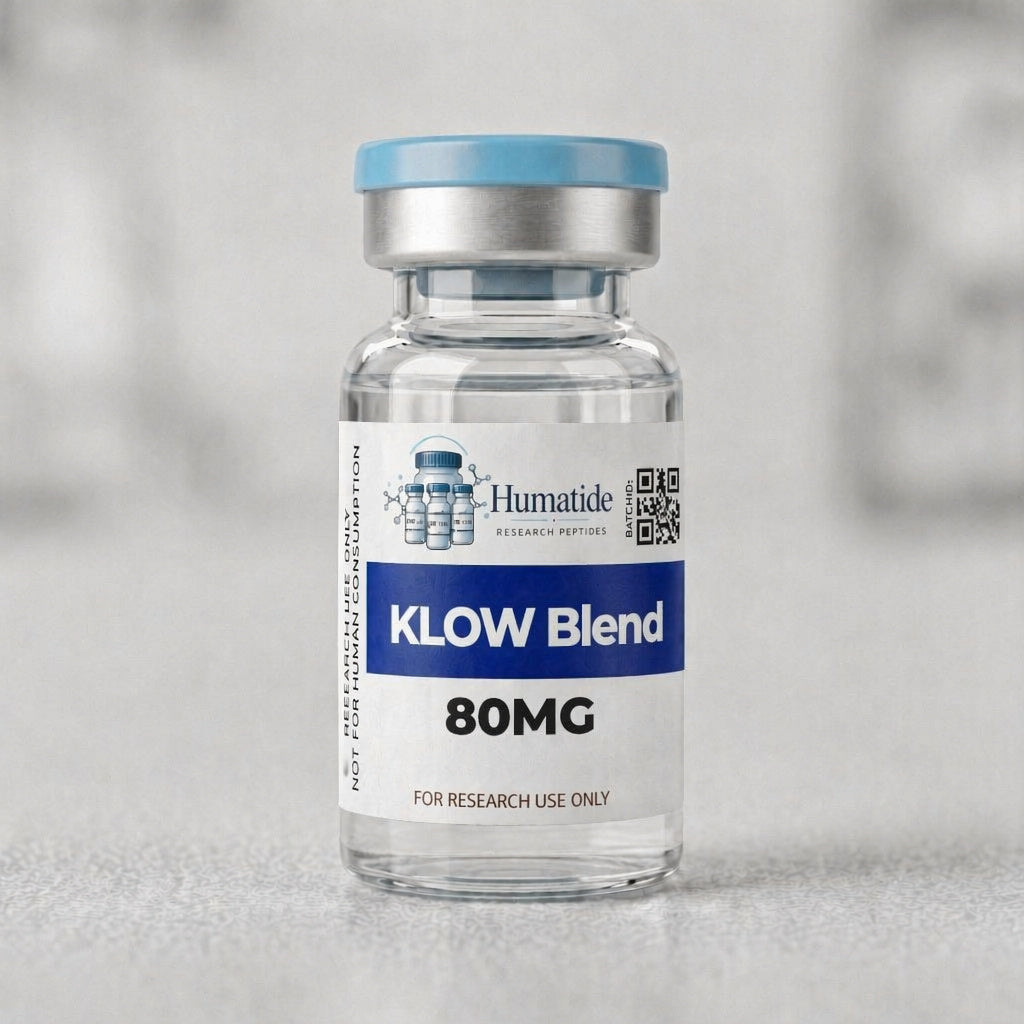
This is a blend (80mg) each of BPC-157 (10mg) + TB-500 (10mg) + KPV (10mg) + GHK-Cu (50mg).
Klow is a blend comprising TB4, BPC-157, KPV, and GHK-CU. TB4(TB-500) modulates actin dynamics to promote cell migration, angiogenesis, and collagen synthesis, supporting connective tissue regeneration; BPC-157 upregulates relevant factor expression, enhances angiogenesis and fibroblast activity, repairs multiple tissues, and provides cellular protection; KPV suppresses pro-inflammatory factors, reduces inflammation, and promotes mucosal repair; GHK-Cu stimulates collagen production, regulates inflammation and antioxidant activity, and supports tissue repair. The four peptides complement each other: TB500 and BPC-157 provide migration-angiogenesis-matrix templating, KPV blocks inflammatory negative feedback, while GHK-Cu stabilizes collagen cross-linking and scavenges free radicals. This forms an “anti-inflammatory-migration-regeneration-remodeling” closed loop, enabling Klow to significantly accelerate repair, reduce scarring, and restore function in soft tissue injuries, postoperative healing, skin aging, and mucosal ulcers..
| Specification | BPC-157 | GHK-Cu |
|---|---|---|
| Sequence | Lys–Pro–Val | Gly-His-Lys |
| Molecular Formula | C₁₆H₃₀N₄O₄ | C28H46CuN12O8 |
| Molecular Weight | 342.43 g/mol | 744.3 g/mol |
| PubChem CID | 125672 | 9831891 |
| CAS Number | 67727-97-3 | 130120-56-8 |
| Synonyms | ACTH(11-13), alpha-MSH(11-13) | Thymosin-β4 fragment 17-23, TB-500 acetate, Ac-LKKTETQ |
| Specification | KPV | GHK-Cu |
|---|---|---|
| Sequence | Lys–Pro–Val | Ac-Leu-Lys-Lys-Thr-Glu-Thr-Gln (Ac-LKKTETQ) |
| Molecular Formula | C₆₂H₉₈N₁₆O₂₂ | C₃₈H₆₈N₁₂O₁₄ |
| Molecular Weight | 1419.5 g/mol | 889.0 g/mol |
| PubChem CID | 9941957 | 62707662 |
| CAS Number | 137525-51-0 | 885340-08-9 |
| Synonyms | PL-14736, Body-Protection Compound-157, Bepecin | Bisprezatide copper;DL1TR6W6VM |
For Research Use Only
This compound is provided exclusively for in vitro laboratory research. It is not intended for human or animal consumption, diagnosis, treatment, or medical use. Not for dietary, cosmetic, or veterinary purposes. This product has not been evaluated by the U.S. Food and Drug Administration or any other regulatory authority.
Disclaimer
All information is for educational purposes only. Humatide makes no claims regarding efficacy or safety. Purchasers are responsible for ensuring proper handling and use in compliance with all applicable laws and regulations.
Terms of Sale
By purchasing from Humatide, you confirm that you are a qualified researcher with the knowledge and facilities to safely handle and store research chemicals. All sales are final. Humatide assumes no liability for misuse, misrepresentation, or unintended consequences arising from the use of this product.
ALL ARTICLES AND PRODUCT INFORMATION PROVIDED ON THIS WEBSITE ARE SOLELY FOR INFORMATION DISSEMINATION AND EDUCATIONAL PURPOSES.
The products provided on this website are intended exclusively for in vitro research. In vitro research (Latin: *in glass*, meaning in glassware) is conducted outside the human body. These products are not pharmaceuticals, have not been approved by the U.S. Food and Drug Administration (FDA), and must not be used to prevent, treat, or cure any medical condition, disease, or ailment. It is strictly prohibited by law to introduce these products into the human or animal body in any form.
Polypeptide Purity Control and Verification Technical System
Humatide.com provides peptides with purity exceeding 99%. Humatide achieves precise control and scientific verification of polypeptide purity by integrating advanced technologies and a full-process quality control system: In the synthesis stage, automated solid-phase peptide synthesis (SPPS) is employed to accurately assemble amino acid sequences. A gradient purification strategy ranging from medium-pressure liquid chromatography (MPLC) to preparative high-performance liquid chromatography (Prep-HPLC) is utilized, optimizing mobile phase composition and elution conditions based on the physicochemical properties of the target peptide (hydrophobicity, charge distribution, etc.) to efficiently remove impurities. For purity detection, reverse-phase high-performance liquid chromatography (RP-HPLC) serves as the core technique, separating components through the distribution difference of molecules between the stationary phase (hydrophobic packing) and the mobile phase (polar solvent). Purity is determined via retention time matching and peak area normalization. Meanwhile, electrospray ionization mass spectrometry (ESI-MS) is combined to precisely verify the molecular weight and composition through mass-to-charge ratio (m/z) analysis, eliminating structurally heterogeneous impurities. Quality management covers the entire chain from raw material acceptance, synthesis process monitoring to finished product release. A continuous quality fingerprint is constructed using multi-dimensional indicators (HPLC purity, MS molecular weight, solvent residue, etc.), and batch data traceability is achieved through a laboratory information management system (LIMS), ensuring each batch meets the prespecified purity standards. This system provides a reliable technical guarantee for preparing high-purity polypeptides through the organic integration of process optimization, multi-dimensional detection, and full-process quality control.
Concepts of High-Performance Liquid Chromatography (HPLC) and Mass Spectrometry (MS)
High-performance liquid chromatography (HPLC) is a separation technology widely used by Humatide for peptide purification. Driven by a high-pressure pump, the mobile phase carries samples through a chromatographic column packed with a specific stationary phase, achieving separation based on differences in the distribution coefficients of components between the two phases. It features high separation efficiency, fast analysis speed, and strong detection sensitivity, enabling precise capture of subtle differences between target peptides and impurities such as sequence analogs or deletion peptides.
Mass spectrometry (MS) is an analytical method that converts peptide molecules into gas-phase ions through ionization technology and separates/detects ions based on their mass-to-charge ratio (m/z). It can accurately determine the molecular weight of peptides and infer amino acid sequences through fragment ion information, serving as a key technology for verifying peptide structural correctness. The combination of these two techniques allows Humatide to establish a complete quality control system from both purity separation and structural confirmation perspectives. Both methods are high-precision peptide detection technologies that scientifically demonstrate the purity and composition of peptides ordered from Humatide.com.
Humatide is committed to translating cutting-edge analytical technologies into tangible quality assurance. Our peptide synthesis laboratories are equipped with high-resolution mass spectrometers and ultra-high-performance liquid chromatography systems. Through real-time detection and data comparison of samples at each production stage, we continuously optimize synthesis processes to ensure every peptide product is delivered to customers with exceptional purity.
Recommended Peptide Purity Levels
Humatide provides only the highest-purity peptides (purity ≥99%) for research and development. The minimum recommended peptide purity level for specific applications depends on the application:
• In biochemical research, peptides used for enzyme activity analysis typically require ≥85% purity.
• In drug development, peptides for preclinical trials must meet >98% high-purity standards to ensure biological activity and safety.
• For diagnostic applications (e.g., antigen peptides in immunoassays), recommended purity is 90%-95% to guarantee detection specificity and sensitivity.
Humatide is confident in the quality of all our products, implementing strict quality monitoring at every stage of peptide synthesis—from crude peptide purification to final product release. Through multi-step purification and verification processes, we ensure each batch meets or exceeds the purity requirements for specific applications. Examples of acceptable minimum purity levels are as follows:
High Purity (>95%)
• Polypeptide drug research and production
• Preparation of targeted therapeutic drugs
• Raw materials for biological diagnostic reagents (e.g., ELISA, immunoassay kits)
• Development of polypeptide vaccines (therapeutic/preventive)
• Preparation of targeting peptides for antibody-drug conjugates (ADCs)
• Polypeptide reagents for life science research (e.g., receptor agonists/antagonists)
• Research on targeting peptide modification for gene therapy vectors
• Development of polypeptide antibiotics/antimicrobial peptides
• Preparation of polypeptide hormone analogs (e.g., insulin analogs)
• Reference standards for biomarker detection
• Research on cell culture additives
• Synthetic peptides for protein structure analysis and functional studies
Moderate Purity (>85%)
• Early-stage activity screening in polypeptide drug research
• Peptide additives for industrial enzymes
• Signal peptide raw materials
• Surface modification of biomaterials (e.g., medical catheters, tissue engineering scaffolds)
• Preparation of agricultural antimicrobial peptides
• Cell adhesion research
• Raw materials for polypeptide surfactants/detergents
• Polypeptide reagents for preliminary mechanistic research in scientific studies
Lower Purity (>70%)
• Preliminary structure-activity relationship (SAR) studies
• Initial verification of protein binding
• Primary cytotoxicity screening
• High-throughput screening of polypeptide drug lead compounds
Please note
**We are not responsible for reconstitution or any issue that arise from it**
High-purity polypeptides are suitable for scenarios requiring strict purity. The ultra-high-purity peptides provided by Humatide can meet and exceed all prespecified purity standards.
To View the latest Certificate of Analysis (CoA) click the "View Latest 3rd Party Certificate of Analysis" button on the product page. Please use that if you are looking to buy as that is the batch you'll receive if you place an order. The QRCode will give you the Batch ID/Lot Number which is matched on the CoA to validate that CoA matches your specific vial. If you happen to get a vial that is from a previous batch select the "Previous Batch 3rd Party Certificate of Analysis" if your Batch ID doesn't match the latest CoA.
All CoA are searchable via the respective testers' website.
ILS Labs Verification is available on their website at:
To validate the CoA on the ILS Labs website enter the Access Code that is located on the bottom of the CoA that is shown on our website.
We also use MDx Biolabs, verification is available via their website at:
https://mdxbiolabs.com/certificates-of-analysis
To find validate the CoA on the MDx Biolabs website enter the COA number which is located at the bottom of the CoA that is shown on our website.

Be the first to know about new products, sales, and exclusive offers.